Category Archives: Recipes

Nurture with Nopal

I have a fairly good-sized prickly pear cactus growing in my yard that arrived there by bird farmers or some other means and it has yielded a few pears over the past two years. Our neighbor’s desert tortoise is particularly fond of the pads and she often snacks on them. The Mexican name for this cactus is nopal or nopales and it is a source of food, nutrition and, possibly, medicines for humans.

Nopales are native to Mexico and spread over the Southwest in general. The root species is the Opuntia cacti. There are actually 114 known species of this cactus family and the leaves of all of them are edible. In Mexico, the cactus pads are popular in many foods dishes, using both raw and cooked pads. In the spring, the cacti produce beautiful, colorful flowers that mature into prickly pears or tunas, a seedy fruit that can be made into jam, jellies and juices or eaten fresh. The taste is described as a blend of watermelon and strawberry, but I haven’t noticed it so much. I tasted the uncooked pad and found a similar taste to watermelon with just a touch of sweetness.

Using Cacti

When dealing with this cactus, you need to take care to avoid the many little spines that inspire the name prickly pear. Gloves or tongs are very useful in handling these items. In order to use the pads or the pears in cooking, you need to carefully remove the spines. Here’s a video from Rivenrock Gardens, a company that sells Nopales, on how to clean the pads.   Cleaning Pads

The pears are equally as tricky to work with, but there is a quick trick to peeling them and using them without stabbing yourself. Using tongs or forks to handle the pear, you follow the basic directions in this video from The Produce Guy for cutting the pear, just being careful not to touch them with your hands. It helps to wear gloves. If you buy them at the grocery, they are probably already cleaned of the spines so they are safe to handle.

Here’s a tip: If you do get one of the spines in your hand, use white glue to remove it. Simply spread the glue over the sore spot, let it dry and pull it out. It will grab the hair fine spine with it.

Health Benefits

At this time, many of the possible health benefits are being researched, but it is believed to be of use in treating type 2 diabetes. It is high in fiber and pectin, which can reduce sugar absorption in the digestive tract. It is also rumored to be good for treating colitis, obesity and high cholesterol. As more research is done, it will be interesting to see if this is an effective food.

Nutrition information for 149 g (about 1 cup)
Calories:22 Fat:0 g Net Carbs:2.0 g Protein:2 g

I have only used Nopal a few times in the past couple of years, but here is a recipe from this site:

Prickly Pear and Orange Marmalade

Here’s a new recipe that uses the pads:

Nopalitos with Chorizo and Eggs

1 young Nopales Pad, cleaned trimmed, and cut into strips
1/2 cup Pico de Gallo
1 Serrano Pepper, chopped
4 large Eggs
1 teaspoon Mexican Oregano
1 teaspoon Chile Powder
1/2 cup Chorizo sausage
1/2 cup shredded Cheddar Jack Cheese
1/4 cup Queso Fresco
4 Low Carb Tortillas, 7 inch

Cook strips of nopalitos in water with 1/2 teaspoon salt and 1/2 teaspoon oregano. Drain when they are tender.

In a skillet, heat one tablespoon oil, then add the nopalitos for a few minutes. Add the Pico de Gallo, Mexican oregano and Serrano peppers and continue to cook until the onions are almost done. Remove to a bowl.

Add a little olive oil to the pan, then add chorizo sausage and stir fry until it is lightly cooked. Add the vegetables back to the pan and add chile powder.

Beat eggs in a bowl, add a bit of salt and pepper and a little more oregano. Add eggs into the mixture, continuing to stir as they cook. Sprinkle cheddar jack cheese over the top and remove from the heat.

Warm up tortillas over the burner or in the oven. Serve eggs and sprinkle a little Queso Fresco over the top.

Serve with tortillas. Makes 4 servings

Nutrition Info per serving
   Calories: 339 Fat: 24.1 g Net Carbs: 6.9 g Protein: 23.3 g

* If you can’t find tortillas, you can eat them with a low carb flat bread or pita bread or without bread. Low Carb tortillas are 3 nc per tortillas, so that would be 3.9 nc for the meat and vegetables.

All comments relevant to my posts are welcome. SPAM is not. If the post has nothing to do with my site content, it will not be posted

Information for this article came from Wikipedia, Web M.D.Nopal ExportNutrition and You.com and Rivenrock Gardens

All photos taken by R. Averett and copyright Skinny Girl Bistro

Munching on Mung Beans

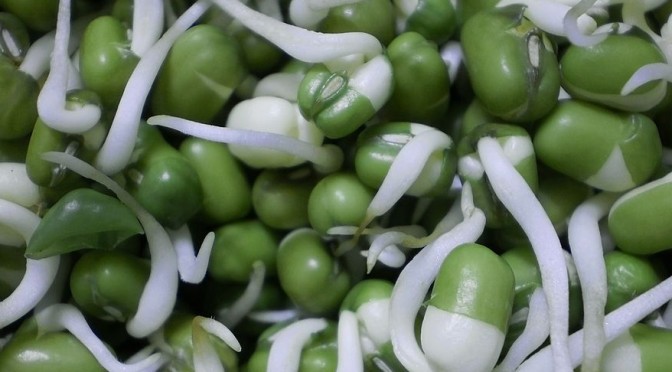
Well, not really. I haven’t actually seen a mung bean in my grocery store, so I suspect I will need to visit an Asian market to actually find the bean. But what I do find at the market is bean sprouts and the majority of those consumed in the United States are from the mung bean seed. Those are those delightfully crunchy sprouts that go so well in Chinese food and in salads. But as for the beans themselves, they are also mashed into a mung bean paste that is used in Asian and Indian cooking. What are we missing out on?

Actually, the bean is usually dried for use, then boiled until they are soft. The paste can be made by removing the outer hull, cooking and then pulverizing the beans until they are a dry paste. In some regions of India, the hulled beans are used to make mung dal.  Other areas of India season the whole beans with spices and fresh coconut to make sundal.

Chinese cuisine used the whole bean to make a dessert called lǜdòu tángshuǐ. Dehulled mung beans and mung bean paste are used in Hong Kong to make ice cream. Mung bean paste is used as a filling for mooncakes in East China and Taiwan. Boiled and shelled beans are used as filling in rice dumplings that are eaten during the dragon boat festival.They can also be blended into a sweetened beverage.

In Indonesia, the beans are cooked with coconut milk and ginger to make es kacang hijau, which is a porridge-like dessert. Monggó guisado or balatong is a Filipino stew of whole mung beans with prawns or fish. Again, mung bean paste is used to make a sweet pastry called a hopia that is popular in the Philippines, Indonesia and Guyana, where it is called a black eye cake.

History

Since ancient times, the mung bean has been grown in India and is now widely grown in southeast Asia, Africa, South America and Australia. It seems to have been cultivated in the United States as early as 1835 where it was known as the Chicksaw pea. Although the beans are widely grown for human consumption, they can also be used as a manure crop and as forage for livestock.Of the fifteen to twenty millions pounds of mung bean consumed annually in the US, nearly 75% is imported. The rest is primarily grown in Oklahoma.

The mung bean sprouts are what we see most often in groceries. They are high in protein, calcium, phosphorus and some vitamins as well as low calorie and low carb. This makes them very important for providing protein in areas where people don’t have many other sources.

1200px-Bean_sprouts_04
Mung Bean sprouts – Photo from WikiCommons – “Bean sprouts 04” by Anna Frodesiak – Own work. Licensed under CC0 via Wikimedia Commons


Nutrition information
Mung Beans 1 tablespoon
Calories: 45, Fat: 0.2 g,Net Carbs: 5.9 g, protein: 3.1 g

Bean sprouts 1 cup
Calories 31, Fat 0 g, Net Carbs: 4 g Protein: 3 g

Recipes

Asian fusion “Dirty” rice. Photo by R. Averett

Here’s a trio of recipes on Skinny Girl that use bean sprouts in them. I think I need to expand my use, although I do use them often in salads.

Egg Foo Yung
Orange Chicken
Asian Fusion “Dirty” Rice

 All comments relevant to my posts are welcome. SPAM is not.  If the post has nothing to do with my site content, it will not be posted.

Information for this article came from Purdue University – Alternative Field Crops Manual, Wikipedia, Food for LifeFood for Awakening

Top Photo from Wiki Commons, used with permission – “ചെറുപയർ മുളപ്പിച്ചത്” by Edukeralam, Navaneeth Krishnan S – Own work. Licensed under CC BY-SA 3.0 via Wikimedia Commons

Love My Leeks

I have a long relationship with leeks. Must be that Celtic passion thing I have going because I’ve always loved leeks in my potato soup. So naturally when I stopped eating potatoes, I simply added leeks to my cauliflower soup and my casseroles and other dishes. They bring a mild onion taste that is uniquely their own. Usually, I use them as a complementary flavor to a dish, although you can eat leeks as the focal point in the dish. I recall reading that Saint David, in Welsh Dewi Sant, was said to have eaten only leeks during fasts. Okay, I don’t like them that much, but they are a great addition to many dishes from soups and stews to vegetable dishes.

Although the white bulb part is usually the big attraction for cooks, the green portion of the leek is also edible and cooks up very well. I cut up from two-thirds to three-quarters of the leeks when I clean and chop them.They do need to be cleaned very well though as those long leaves tend to hide soil within them. Once I cut them up, I run them under water in a colander and swish them around to make sure the dirt is off. They can then be put in plastic bags and kept in the crisper of the refrigerator for several weeks or frozen for three or more months.

History

Since they look like an over-sized scallion (green onion), it’s no surprise that they’re related to onions, garlic, scallions and shallots. Leeks can be traced back in culinary history for thousands of years. Believed to originate in Asia, there is evidence for them all over the Middle East and Europe. The ancient Greeks and Romans used them extensively and the latter most likely introduced them to Great Britain where they thrived. Leeks took hold with the Welsh and eventually became the national symbol of Wales. Folklore records that the aforementioned Dewi Sant encourage Welsh warriors to wear leeks in their caps to make it easy to identify their comrades during a battle against the Saxons that proved successful for the Welsh.

Recipes

leeks-a-z

Here are a few recipes from Skinny Girl that use leeks:

Cennin gyda Thomato a Bacwn – Leeks with Tomatoes and Bacon
Smashed Turnips with Leeks
Asparagus Leek Cauli-risotto
Creamy Cock-a-Leekie Soup
Spring Time Pasta

Nutrition information for 124 grams (a little over 1 cup sliced)
Calories: 38 Fat: 0 Net Carbs: 8 g Protein: 1 g
Information for this article was gleaned from World’s Healthiest Foods,   Wikipedia, and Specialty Produce

Top photo from Wiki Commons, used with permission – “13-08-31-wien-redaktionstreffen-EuT-by-Bi-frie-031” by Bi-frie (talk) – Own work. Licensed under CC BY 3.0 via Wikimedia Commons


Join In on Jicama

Oddly, even though I grew up adjacent to Mexico and thrived on Mexican food, jicama was something I really didn’t encounter. Not even when I moved to Southern California.  I didn’t “discover” it until about ten years ago when I spotted the odd-looking root in the grocery and decided to try it. What I found was an unusual vegetable that has a crisp, clean flavor and a bit of sweetness. It reminded me of an apple in texture and in crunch.

Most frequently, jicama seems to be cut into small sticks or grated and put into salads and slaws, where it does an admirable job. It can also be cooked, baked, boiled or fried. One of the interesting characteristics is that it doesn’t get soft. It keeps the crispness, which makes it great for a dipping chip, even if you fry it. It adds a bit of crunch to a stew while substituting for a higher carb’d vegetable.

Cultivated South of the Border

Pronounced hee-ca-ma, it is also called yambean, although it is not a yam. Jicama is native to Mexico and South America. It is part of the legume family and grows a vine in tropical and semi-tropical climates. The edible jicama root is a globular shape and has been referred to as Mexican turnip, although the flavor is nothing like a turnip, or Mexican water chestnut, which it resembles in crunch. Other names for it are bengkoang, sengkwang and yacon. The flavor suggest that it would also be good in Asian food as a water chestnut substitute. It is grown in Asia and in other tropical and semi-tropical areas, including Florida, Hawaii and Puerto Rico.

Nutrition Info per 100g (about3.5 oz)
Calories: 38 Fat: 0.19 g Net Carbs: 3.8 g Protein: 0.72 g

Jicama, how do I love thee?

Let me count the ways:

  • Peeled and cut into sticks as a snack.
  • Cut into rounds and fried as a dipper instead of potato chips.
  • Chopped and added to stir-fry.
  • Shredded and added to salad.
  • Cut into sticks and Tampura battered and fried.
  • Sliced and spread with peanut butter and sugar free jam.
  • Sliced and sprinkled with cinnamon and sugar substitute.
  • Sliced and roasted, then topped with cheese and bacon.
  • Sliced and sprinkled with lime juice and a bit of chili powder.
  • Cut into cubes and mixed with strawberries and blueberries in a fruit salad.
  • Or mixed with cantaloupe and honeydew melon in a fruit salad.

There are more ways than I can count to use this versatile vegetable.   If you have other ways you’d like to share, let me know.

Here are two ways to use jicama from this site:

Root Vegetable Fries (on the Celeraic page, go to the bottom)
Sizzlin’ Hot Snacks (toward the bottom, snack options with  beets, daikon and jicama)

And here’s a new recipe for jicama for this entry:

Cinnamon Battered Jicama Sticks

12 Jicama sticks, about 3 to 4” long, 1/2 inch cubed
1/4 cup Low Carb Flour
1 Egg
1/4 teaspoon Baking Powder
1 teaspoon ground Cinnamon
1/2 teaspoon ground Cardamom
2 tablespoons Sugar Substitute
1/4 cup sugar free Raspberry Jam or preferred flavor
Coconut Oil

Mix the flour, egg, baking powder, sugar substitute and spices together to make a batter.

Heat enough coconut oil in a small pan to bring it to about 1/2 inch. Reduce to a medium heat.

Dip a jicama sticks into the batter, then carefully slide into the pan of oil. Cook about three at a time until golden brown, then turn over to cook the other side to golden brown or spoon the oil over the top while cooking to brown the top. This only takes a couple of minutes. Remove to paper towels to drain. Spread with sugar free raspberry or other jam of choice.

Makes 12 snacks.

Nutrition info per snack
   Calories:16 Fat: 0.7 g Net Carbs: 2.0 g Protein: 0.8 g

All comments relevant to my posts are welcome. SPAM is not.  If the post has nothing to do with my site content, it will not be posted.

This article used the following for reference: Specialty ProduceNutrition and You,  Natural Society Newsletter

Top photo from WikiCommons, used with permission – By Wicki (Own work) [Public domain], via Wikimedia Commons

Iceberg is Ideal for Salads

Really, it is. Oh, sure, there are those that criticize, saying that it lacks in any real nutritional value and maybe there is truth to that. But Iceberg Lettuce has a clean, refreshing taste and keeps pretty well in your refrigerator for at least a week, which some other lettuces don’t do as well. Although it’s low in nutrition, it is only a little below Romaine lettuce, which is my other favorite lettuce. The Iceberg lettuce is largely water, but it has a sweet, clean taste where some of the other, more nutritious lettuces, can be a bit bitter and not as refreshing. The ideal, in my opinion, is a mix of the lettuces for variety.

Iceberg lettuce is the one you find most frequently in restaurant salads. The lettuce is also great on sandwiches or for making lettuce wraps because of its nicely cupped, large leaves. It is the primary lettuce used in the United States.

Lettuce Origins

All lettuces trace back to the Mediterranean area where lettuce was first cultivated for its leaves in ancient Egypt, with evidence of that dating to about 2680 BC. Originally, it was grown for the oil produced from its seeds. The Egyptians considered it the sacred plant of Min, their god of reproduction. The cultivated variety appeared to be about 30 inches tall and resembled a larger version of the modern romaine lettuce. The Egyptians passed the seeds along to the Greeks, who then shared with Romans and more varieties were developed. Writings by Joachim Camerarius in 1586 described the three basic varieties of modern lettuce, which are loose leaf, romaine and head lettuce, such as iceberg and butter.

Christopher Columbus brought the lettuce to America in the late 15th century. Meanwhile, more varieties were being developed in Europe. Many of these are still grown in gardens today. I grew a mixture of lettuce a couple of years ago, but pulling leaf by leaf didn’t seem very rewarding. I grew a butter lettuce last summer and that was good, but you only get one head per plant, although after I harvested it, the plant did continue to produce leaves. In the late 19th century, documentation indicates between 65 and 140 distinct varieties.

Because lettuce has a relatively short life span once it is harvested, it didn’t expand into wide spread use until the 1900’s when packing, storage and shipping technology improved. To ship the fresh vegetable long distances,in the 1920’s, crisp head lettuce was shipped in train cars, filled with crushed ice to keep the lettuce chilled. The crisp head lettuce shipped this way came to be known as iceberg lettuce since the ice resembled icebergs. Incidentally, prior to the advent of ice-making facilities, ice used to be harvested in the Sierra Nevada mountains near Donner lake and brought down by train to Sacramento for shipping fresh produce. In the 1950’s vacuum cooling revolutionized the industry. This allowed the lettuce to be cooled and packed in the field, which kept it fresher to market.

Lettuce Uses

Around 50 AD, the Romans cooked and served lettuce with an oil and vinegar dressing, although they sometimes ate them raw. Between 81 and 96 AD, the lettuce salad prior to a meal became a tradition. In China, salads were made primarily from cooked vegetables and the lettuce was worked into all kinds of dishes from wraps to stir-frys and in other meat dishes along the way. Now days, we use lettuce in salads, wraps, sandwiches, and other ways and occasionally still cook it.

Personally, I haven’t tried cooking iceberg lettuce, although some of the loose-leaf varieties seem like they would go well in a skillet of greens. However, I did find a recipe from OceanMist for Fire Charred Iceberg Salad. This just might tempt me to try it. If you do it first, report back, please.

Nutrition Information for iceberg lettuce – 1 cup
Calories:10 Fat: 0 g Net Carbs: 1 g Protein: 1 g

Here are a couple of my quick and easy recipes for lettuce cups, which are really great for a low carb lifestyle.

Taco Lettuce Cups

4 large leaves Iceberg or Butter lettuce
1/2 lb Ground Beef
1/4 lb Chorizo
1 tablespoon Taco Seasoning
1/4 cup Pico de Gallo
1/2 cup chopped Baby Corn
2 tablespoons Black Beans
1/4 cup Butternut or Acorn Squash, cubed
1/4 cup Salsa
1/2 cup Cheddar Jack Cheese, shredded
1 small Avocado

Precook squash in the microwave or in a suacepan with a little water until it is fork tender. Cut into samller pieces.

Cook ground beef and chorizo in a skillet until lightly browned. Add taco seasoning, squash and a little water to make a moist filling. Stir in the baby corn and beans. Cook about three to five minutes to heat the corn and beans.

Put the lettuce leaf on a salad plate, spoon 1/4 of the ground meat on it, then top with Pico de Gallo and 1 tablespoon of Salsa. Add about two tablespoons of jack cheese over the top, and crown with slices of avocado. Fold the lettuce over and serve with sour cream.

Makes 4 tacos.

Nutrition Info per taco:
Calories: 424.8 Fat: 33.3 g Net Carbs:6.1 g Protein: 22.3 g

All comments relevant to my posts are welcome. SPAM is not.  If the post has nothing to do with my site content, it will not be posted.

Information for this article was helped by these pages:  Wikipedia, About Health, Livestrong.com and Oceanmist.com

All photos are by R. Averett, Copyright Skinny Girl Bistro