Recently, I stopped by Carl’s Jr. for one of their low carb burgers and spotted the photo for their yummy-looking French fries with bacon and cheese. Oh, my mouth watered for that! It looked so delicious… But I was good and just ordered the burger, but I started thinking about the potato substitute options with cheese. I decided to try cauliflower with it and to do something I’ve not done with this vegetable before; I fried it. And with that, this side dish was born.
Cheese and Bacon Fried Cauliflower
1/2 head Cauliflower, cut into flowerets
4 slices thick cut Bacon
1` cup Cheddar Cheese, shredded
1/2 cup Oil
Seasoning Salt to taste
Bring a pot of water to a boil and add the cauliflower. Cook for 5 minutes, then drain and let cool five minutes.
Heat the oil in a skillet to about 350 degrees over medium high heat. Add about 1/4th of the cauliflower flowerets to the hot oil and cook until golden brown, then turn over and cook until the backside is golden brown. Remove to a paper towel to drain. Cook the rest of the cauliflower in the same-sized batches and let them drain.
Preheat oven to 365 degrees (F.)
Cook the bacon until crisp, let cool, then break it into pieces.
Prepare a baking pan with a layer of aluminum foil and spread the cauliflower into four groups on the sheet. Put 1/4 of the bacon pieces on each group of cauliflower, then sprinkle 1/4 of the cheese on top of each.
Put in the oven for 5 minutes to melt the cheese. Remove with a spatula to plates to serve.
Makes 4 servings.
Nutrition Information per serving: Calories: 195 Fat: 14.9 g Net Carbs:2.4 g Protein: 12.1 g
Want to score an eBook copy of my LC15 series Mexican Food for a Low Carb Lifestyle for free? Just sign up for my blog mailing list! You’ll be directed to my thank you page where you can download a copy in PDF, Kindle or iBook format.
Sometimes a one-dish meal is a great choice for a light dinner. Bacon and cabbage is quick and delicious, but like a certain TV chef, I like to “kick it up a notch” or two. In this version, I add spinach, mushrooms, and kohlrabi to the mix. This makes a great dinner or a yummy side dish and it is low carb without any special ingredients.
Spinach and Cabbage with Bacon
3 cups Cabbage, shredded
4 slices thick-sliced Bacon
1/3 cup Green Bell Pepper, chopped
1/3 cup Onions, chopped
1 teaspoon Garlic, minced
1 cup Spinach, fresh
1/2 cup Kohlrabi, cubed (or Turnips)
1/2 teaspoon Seasoning Salt
1/4 teaspoon Black Pepper
1/3 teaspoon White Wine Vinegar
1/3 cup Mushrooms, sliced
Cook the kohlrabi in water until it is fork tender. Drain. In a deep pan, cook the bacon until almost crisp. Remove to a paper towel and pour off all but 1 tablespoon of bacon grease. Let bacon cool, then tear into pieces. Add the garlic, onions and bell pepper and sauté until the onion is glazed. Add the kohlrabi, bacon, mushrooms, and seasonings, then continue to stir and fry until the mushrooms are lightly browned.
Stir in the spinach leaves, then add the shredded cabbage. Stir cook the cabbage until it Is limp and just tender, but is not overdone. Remove from the heat and stir in the vinegar. Serve.
Close up of the spinach and cabbage dish showing all the great, appealing colors.
Makes 2 dinner servings or 4 side-dish servings.
Nutrition Info per dinner serving: Calories: 197.2 Fat: 12.4 g Net Carbs: 7.5 g Protein: 9.3 g
Nutrition Info per dinner serving: Calories: 98.6 Fat: 6.2 g Net Carbs: 3.8 g Protein: 4.7 g
When I was younger, and heavier, carrot salad was a favorite of mine, especially the kind with pineapple and raisins in it. Sadly, two of those three items are a little high on the carbs to endulge that salad. In fact, when I first started on Atkins, carrots were not part of phase 1 or phase 2 of the eating plan even though they aren’t that high in carbs. I still eat them sparingly, but have incorporated them into a few recipes.
I came up with this combination of vegetables and fruits to create a slaw that is similar to the carrot salad. It is really good and has quickly moved into my list of favorites. This would be a really great salad with your holiday dinner.
The challenge in ingredients may be to get fresh kohlrabi. It is a cold weather crop so it may be available now, but it is not a common one in the markets in my area. I have convinced one of my local stores to carry it and I buy it whenever I see it. It keeps very well in the refrigerator for a month or two. It can also be peeled, sliced and frozen easily. If you can’t find kohlrabi, you may try substituting broccoli stems, but while the flavor is similar, it is stronger.
Cranberry, Carrot and Kohlrabi Slaw
1/2 cup Carrots, grated
1/2 cup Kohlrabi, peeled and grated
1/2 cup Daikon Radish, peeled and grated
1/4 cup Broccoli, finely chopped
2 tablespoons Cranberries, finely chopped
1 tablespoon sugar substitute (liquid preferred)
2 tablespoons Mayonnaise
In a medium bowl, combine the chopped and grated vegetables and mix together. In a small bowl, mix the mayonnaise and sugar substitute together.
Add the mayonnaise mix to the vegetables and mix well. Chill and serve. Makes 4 servings.
Nutrition info per serving: Calories: 64.5 Fat: 5.1 g Net Carbs: 2.1 g Protein: 0.6 g
If you make this with one tablespoon of sugar rather than sugar substitute, then it changes the nutrition info to: Calories: 73.3 Fat: 5.1 g Net Carbs: 5.1 g Protein: 0.6 g
Just about anything with bacon is a winner for me. I love it and I love the over 100 years-old woman who claimed her longevity came from eating bacon every day. I’m in for that! A BLT sandwich is really great also and I have finagled a couple of ways to eat one on a low carb diet with low carb breads that are very tasty. But when I saw a recipe come across on Facebook for a BLT Pasta salad, I knew I had to figure an adaptation for low carb. Pasta is one of those things that you don’t eat or eat very sparingly when trying to maintain the lc lifestyle, so I turned to my favorite substitute item for pasta, potatoes, and rice — cauliflower.
So with just a few adjustments and a little enhancement, I present the low carb version of the …
Bring a pan of water to a boil and add the cauliflower. Let cook for about 10 minutes until it is tender. Cut into bite-sized pieces if it is too big. Drain. Put into a large mixing bowl and set aside.
Chop the tomatoes into bite-sized pieces.
Pan fry the bacon or cook in the oven until it is completely done. Remove to a paper towel to drain. Put 2 tablespoons of bacon grease into a skillet and add the garlic, then add the tomatoes and thyme. Cook for about five minutes until the tomatoes are warmed, but not cooked. Crumble the bacon into pieces. Reserve 1/4 cup for garnish.
Add the tomatoes and bacon to the cauliflower and toss together. Add the shredded cheese and lettuce and toss again.
Mix together the mayonnaise, sour cream, and yogurt and add the cumin, chives. salt, and pepper. Pour over the salad and toss to mix it in and coat it. Garnish with reserved bacon and chives. Serve warm. You can add slices of avocado or a tablespoon or two of guacamole if you wish. (Not included in the nutrition info.)
Refrigerate leftovers.
Makes 4 servings.
Nutrition info per serving: Calories: 330.5 Fat: 24.1 g Net Carbs:5.6 g Protein: 21.4 g
If you’d like you can add more lettuce to the salad with only a little more in the carb count.
TIP: This can be a very versatile base salad. Instead of bacon (or in addition for real bacon lovers), substitute in tuna, ham, chicken, or taco meat. The possibilities abound.
Let me know how you like this salad in the comments.
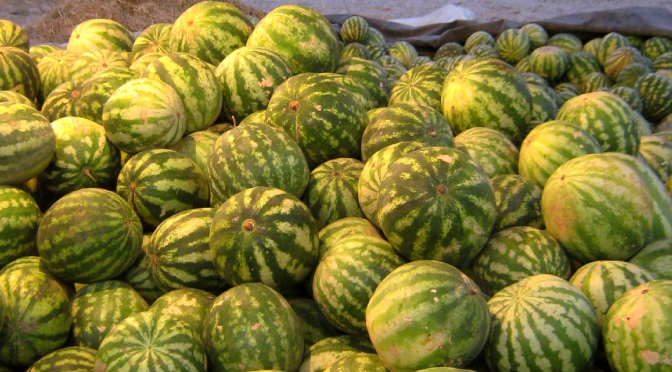
Yes, I am truly reaching for the “X” in this and I have settled on using the Mandarin Chinese name of a commonly known melon… the watermelon. It actually is a specific kind of melon that is grown in China, but essentially, the same as watermelons around the world. The xigua, pronounced shee-gwa, is a small roundish melon with deep green stripes on a lighter green skin.
The watermelon itself is believed to have originated in south Africa and records from Egypt showed it was cultivated in the Nile Valley as far back as 2000 BC. Eventually, it began to spread across Europe and toward the east. Moorish traders carried the fruit to Spain where it was grown in Cordoba and Seville. By the 7th century, it was being cultivated in India and by the 10th century it had reached China, where it really took hold. Today, China is the world’s largest watermelon producer. It came to the Americas with European colonists and their African slaves. Spanish settlers brought it to Florida in 1576. By 1650, it was grown in Peru, Brazil and Panama and other settlers brought it to the British and Dutch colonies while Native Americans in the Mississippi Valley and Florida had begun growing the crop as well. Explorers took the seeds to the South Pacific where they were quickly adopted in Hawaii and other Pacific Islands. Who doesn’t love watermelons, after all? They are colorful, refreshing and delicious.
While I grew up with watermelons used as a dessert, basically a big slice or wedge of watermelon on a plate, I have had to cut back severely on them with a low carb lifestyle. Yes, they are primarily water, but they do have a lot of natural, although flavorful, sugar in them. I remember we used to sprinkle a little salt on the fruit and it would make it taste even sweeter. Mostly, I eat watermelon raw, just chilled and sliced is perfect, or I have actually processed them for a glass of watermelon juice. They also are a great recipe ingredient in salads and salsas.
Of course, it’s easy to make a basic fruit salad with cubed watermelon, cantaloupe, honeydew melon, sliced strawberries, and grapes, but the watermelon has a much larger range than that. It combines well in green salads, goes with avocados, olives, and beets or other vegetables to create different salads. You can even make a watermelon jelly – go ahead, Google it — watermelon lemonade and watermelon sorbet. In fact, I am inspired and when watermelon season comes into full swing this summer, I’m going to try to make a low carb version of a few of these recipes. That’s your cue to come back to see if I can meet this challenge.
Another popular use for the xigua and other watermelons is carving. They are a wonderful artistic medium for food artists and are carved into flowers, animals, and whole scenes. To some artists, they can carve a watermelon the same way you’d carve jade. There are carved melon festivals around the world. Here are a few links to some of these:
Photos are from Wikipedia media Commons and used under public-use agreement. Top photo “Watermelon – Fruit Bazaar – near Besat sq – Nishapur 08” by Sonia Sevilla – Own work. Licensed under CC0 via Wikimedia Commons –
Food Carving photo by Rlevse via Wikimedia Commons