Category Archives: Vegetables & Salads

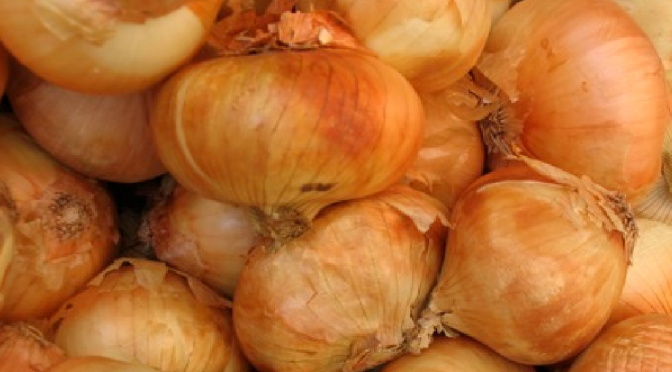
Victorious Vidalia Onions

I say victorious because the Vidalia onion has an unusual history that results from the vegetable’s birth related to the location of its planting and gaining surprising success in spite of its differences. Intrigued? Of course, you are, so read on.

Back in 1931, Mose Coleman, a Georgia farmer in Vidalia, planted a field of onions. When he tasted the onions, he discovered they were sweet, not hot as he had expected. Coleman struggled a little sell his crop, but after some convincing, he sold his first crops for $3.50 for a 50-pound bag, which was actually a very good price for the times. Other farmers weren’t doing nearly so well with their crops. With successful sales came more plantings of the “sweet” onions and the production began to flourish.

In the 1940’s, the state opened a farmers’ market in Vidalia, which was then the crossroads of some major highways. People began to refer to the onions as “those Vidalia onions” and the name was bestowed on this new sweet onion.

With time and research, Georgia agriculture realized that the soil, rain and weather conditions in the southeast of the state were perfect for producing sweet onions. The area has low sulfur soils, which prevents the bulbs from producing the pungent or hot taste that regular onions have. They like a lot of water and this also contributes to their sweetness. Having established that they have a true Georgia treasure, the state legislature declared the onions Vidalia onions and set strict regulations on their production and development. The legislation, passed in 1986, defined a 20-county region of Georgia as the growing area. The Georgia Department of Agriculture trademarked and still owns the name “Vidalia” so the only Vidalia onions come from Georgia.

Since the onions are harvested in spring and summer, that is the only times you are likely to see them in the market. I believe I have seen them now and then at the grocery store, but they are not always available. There are other sweet onions that you can use to make your batter fried onions, but they will have different characteristics. You can substitute Walla Walla onions from Washington state, Texas 1015 onions, Pecos Onions, or Sunbrero from Texas, Imperial Valley Sweet onions from California, Carzalia Sweet from New Mexico, Sweetie Sweet from Nevada, Maui Onion from Hawaii and the Bermuda onion from Bermuda.

Sweet onions are delicious on sandwiches or in a salad, but they also cook up well. They work well with many condiments, such as butter, cardamom, celery, cloves, and curry. They pair easily with mushrooms, asparagus, chiles, broccoli and any other place you might add an onion. The Vidalias bring a sweeter taste than regular onions, but still blend well with most food choices.

Nutrition information for 1 medium onion (148 grams)
Calories: 60 Fat: 0.0 g Net Carbs: 13.0 g Protein: 1.0 g

Recipes:

Almost any recipe on this site that uses onions in curry or a salad could easily benefit from a Vidalia or other sweet onion. But if you would like to try to make your own “Bloomin’ Onion” similar to the Outback’s, you can try this recipe from Alton Brown at Food Network. I tend to stay away from this because it is so delicious and the carbs are not low. You can make it using a low carb flour, but I haven’t tried it. I may see what I can do about creating “Onion Petals” that are a lower carb’d version, if I can find a Vidalia or even a Nevada Sweetie Sweet onion at the market.

Almost-Famous Bloomin’ Onion, by Alton Brown

Featured Recipe:

Vidalia Onion with Bacon Pie

Don’t have Vidalia onions?  You can make these with any of the sweet onions mentioned above.  Or with yellow onions with a little bit of sugar substitute added for sweetness, if you like.

2 Vidalia onions
2 eggs, beaten
1/2 cup sour cream
salt and pepper to taste
1/4 cup butter
2 tablespoons grated Parmesan cheese
1 pinch paprika
2 tablespoons chopped mini-peppers
1 hot dried chile crushed
1/4 cup shredded Parmesan cheese
1/2 cup Bacon pieces

Pie Crust
1/2 cup Low Carb Flour
2 tablespoons Flax Meal
2 tablespoons Lard or Shortening
1 tablespoons cold water
1/4 teaspoon Salt
1 tablespoon Parmesan Cheese, grated

Prepare pie crust by putting the flour and flax meal in a small bowl and mix, then cut in the lard or shortening to make a crumbly mixture. Add the cold water and mix to pull the flour into a ball. Chill for about 30 minutes. Put a sheet of waxed paper on a board and sprinkle a little low carb flour over it. Pat the dough into a circle in the flour on the board, then flip it over. Put another sheet of wax paper over the top and roll out into a circle to make the pie crust. While you are rolling out the crust, preheat the oven to 375 degrees (F.)

Peel off the top paper carefully, then put the crust top down into a  deep -sided 7″ or 8″ pie tin or plate and peel off the bottom paper carefully. If it breaks or sticks to the paper, ease as much in as you can, then make repairs. Crimp the edges of the crust if they come to the top. Pierce with a fork and bake for about 10 to 15 minutes until lightly browned.

Slice onions thinly. Melt 1/4 cup butter in a large, deep skillet and sauté the onions over medium high heat until tender, about 15 minutes.

Break the eggs into large bowl and beat well. Add sour cream, seasonings, peppers and bacon bits and stir together. Add onions with butter sauce and mix together.

Pour the onion filling into the cooked pie crust and spread it around evenly. Sprinkle the shredded Parmesan cheese over the top. Bake for 20 minutes, then lower the oven temperature to 350 degrees (F.) and cook another 35 to 40 minutes until the top is golden brown. Remove from the oven and let cool at least 5 minutes before serving.

Makes 8 servings.

Nutrition info per slice:
     Calories:223 Fat: 18.0 g Net Carbs: 4.4 g Protein: 9.6 g

Resources for the information in this article include  Vidalia Onion,  Food Reference, Specialty ProduceNew Georgia Encyclopedia  and Wikipedia

Top photo from Wikimedia Commons, used with permission – By ryan griffis (originally posted to Flickr as Vidalia Onions) [CC BY-SA 2.0 via Wikimedia Commons]
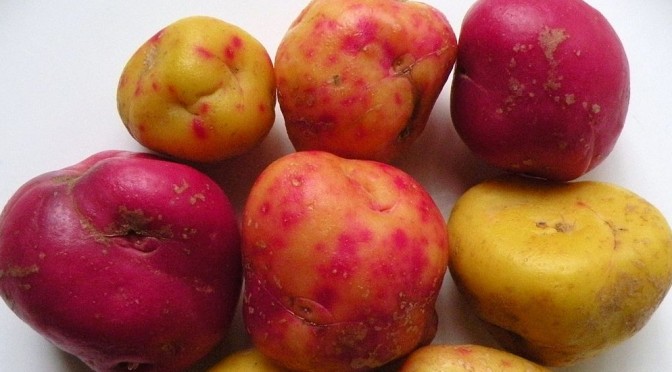
Unveiling Ulluku

I freely admit it. The “U” entry is a definite challenge. In fact, the lower end of the alphabet is a challenge!

I wanted a vegetable that began with “u” and there aren’t a lot of them. But I learned about this one called ulluku, pronounced ou-ju-koo, that hails from the Andes and is basically available in South America and New Zealand. I was in Lima, Peru on business twice in the late 1990’s and it’s quite possible I may have eaten it in one of the fabulous Peruvian meals that I enjoyed while I was there along with Inca Cola, which isn’t a cola at all, but rather a deliciously light beverage made from lemon verbena and is loaded with sugar and caffeine. But I digress.

Ulluku is a tuber that resembles jicama, which I discussed earlier, in that it is crisp and remains crisp, even when cooked. I have not seen it in the United States, but some cities that have more than one Peruvian restaurant might see a dish made with it on the menu. I am sure someone must import it and places like Los Angeles, San Francisco, and New York might have it in a specialty market. However, if you want to try a Peruvian recipe, the recommended substitute for it is jicama.

While I knew the potato was a new world crop, I hadn’t realized that it, too, came from the Andes where the Incas grew them long before the Spanish arrived. The potato made great headway in the world, but the ulluku needs a better publicist because it is a bit scarce. The colorful vegetable does have other names, such as papalisa and milluku in Bolivia, Ecuador, and Peru and as chugua and uyucos in Columbia, while Venezuela refers to them as ruba. They are actually a very important food crop in Peru, coming in second to potatoes in  dietary value. They contain high levels of protein, calcium, and carotene. Unfortunately, they also are a little higher in carbohydrates than I like, but still lower than potatoes.

Nutrition information for 3.5 oz. (100 grams) of ulluku
Calories: 74, Fat: 10, Carbs 14 g Protein: 2.6 g

Ullukus are usually cut into strips and cooked as part of the meals. Because they have a high water content, they don’t bake or fry well, but they can be cooked like a potato in any other way. A popular dish featuring the ulluku is the Peruvian dish olluquito con ch’arki which is Ullukus with Lama meat. You can make it with other meats, so here’s a recipe link from PeruvianFood.com to the version made with carne. I intend to try this recipe using jicama.

640px-Olluquito_con_cerdo_y_arroz_blanco_21042010

Olluquito con Carne Recipe

Information for this article was pulled from Wikipedia, Revolvy, 
AppropediaInca Shamanic Glossary, and GourmetSleuth.com.

Photos are from Wikimedia Commons used with permission- top photo: “Ulluco” by Nzfauna – Own work. Licensed under CC BY-SA 3.0 via Wikimedia Commons
The recipe photo is “Olluquito con cerdo y arroz blanco 21042010″ by Dtarazona Own work. Licensed under GFDL via Wikimedia Commons

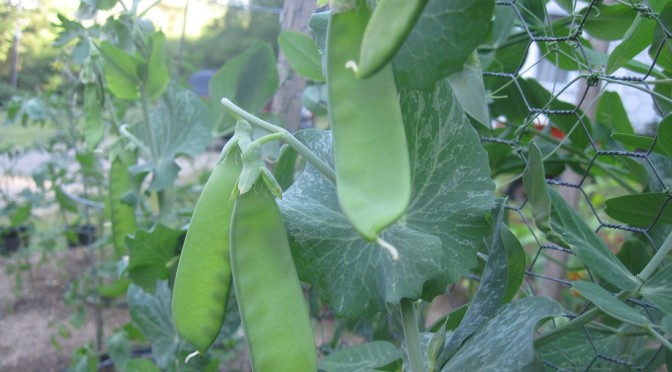
Simply Yummy Snow Peas

They have a nice snap and a sweet taste and make a wonderful addition to Chinese food, curries, and other vegetable combinations. Best of all, as far as peas go, they are reasonably low in carbohydrates. I most associate snow peas with Chinese food, but they can be used in any way you would use other peas. Experiment with them.

Although the snow pea originated in the Mediterranean region and were a popular variety of pea in the 19th century, they migrated to China where they quickly became the preferred pea and a key ingredient in Oriental cuisine. They thrive in a cool climate and should be picked five to seven days after flowering when they are at their peak flavor.

The French call the snow pea the mange-tout, meaning “eat it all” as it is one of only two pea varieties that you can eat the pod. The other pea with an edible pod is the sugar snap pea, although the snow pea has the more delicate pod. Easily recognized, snow peas have pale green pods that hold the small, flattened peas and are about two to three inches in length.

You can buy snow peas either fresh or frozen year round. Add them to stews in the winter or to salads in the summer. Delicious either way.

Nutrition information for 1 cup (98 g)
Calories: 41 Fat: 0 Net Carbs: 4 Protein: 3

Recipes:

Here’s a couple of recipes from Skinny Girl Bistro that feature snowpeas.

Cauliflower and Snow Peas Curry
Summer Harvest Cauli-risotto

Information for this article was taken from Specialty ProduceSelf Nutrition Data,  and Wikipedia.

Top photo is from Wikimedia, used with permission – By Rob Duval (Own work) [CC BY-SA 3.0

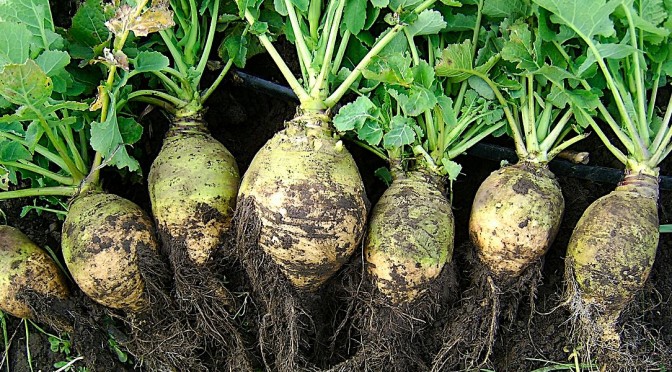
Rutabaga is a Delicious Root

Back quite a few years ago, PK and I put on a Scandinavian feast for the local SCA group. For the uninitiated, that’s the Society for Creative Anachronisms, a medieval recreation group. We tried to find recipes that would go back to the Middle Ages for the feast and it included many interesting and diverse foods from Scandinavia. One of the dishes we made was Lanttulaatikko, which is a rutabaga baked casserole from Finland. It was the first time I used rutabagas and I was pleasantly surprised by their taste. I have only used them rarely since then and now find myself wondering why? They are fairly low carb, although most of the carbs are sugar, and can be used in much the same way as a potato, so I plan to enjoy them more often in my cooking.

Rutabagas have a bit of a confused history, largely because of a mix of names used for them. They are only called rutabagas in the United States and possibly, Canada. Most of the rest of the world calls them swedes, reflecting back to their abundance in Sweden. The name itself is of Swedish origin, coming from rotabagge, meaning “round root”.

Other names for them are Swedish turnips and Russian turnips. In Ireland, they are the “neeps” in “tatties and neeps”, confusing matters further. I mentioned turnips to a friend who had lived in Ireland and she thought I was referring to a rutabaga. While they are believed to be a hybrid between a turnip and a wild cabbage, they have developed a different look and a different taste from a turnip. The vegetable is larger than a turnip with a purple to tan colored skin and the flesh is an orange color with a nutty, sweet taste when roasted. Turnips are white with a bit of purple on them, although some are all white and the flesh part is white and has a slight peppery taste. I’m sure that clears things right up.

Root Vegetables
Various root vegetables from the top left: turnip, rutabaga, daikon radish and the green one at the bottom is kohlrabi.

Rutabagas are a cold weather crop, like turnips, kohlrabi and others from the turnip family. They are primarily grown in the northern United States, Canada, Europe, and Great Britain.

Uses

Rutabagas can be cooked almost any way you cook a potato —  roasted, sautéed, baked, fried, boiled, mashed and added to soups and stews. They can be shredded and added raw to salads.  They make great French fries.

Fun Facts about the rutabaga

In 2011, the rutabaga entered the Guinness Book of World Records as the world’s largest vegetable when a gardener in the U.K. grew one that weighed 85.5 pounds! That is a big rutabaga!

People in the British Isles used to carve turnips and their larger cousins, the rutabaga into their equivalent of the pumpkin on Halloween. Called ‘tumshie heads” the children would carry them to ward off evil spirits. They have now been replaced for the most part with pumpkins.

The annual Rutabaga Curling Championship takes place annually at the Ithaca, New York, Farmers’ Market on the last day of the market season. They literally hurl or curl the rutabagas across the wooden floor.

Nutrition Information per 1 cup of cubed rutabaga (170 grams)
Calories: 66 Fat: 0 g Net Carbs: 12 g Protein: 2 g

Recipes

Here’s a couple of recipes from the Skinny Girl site that use rutabagas:

Corned Beef Hash with Eggs
Cove Soup

Featured Recipe for this blog:

Lanttulaatikko- Finnish Rutabaga Bake

I originally found this recipe in the Betty Crocker International Cookbook and have only made a couple of changes to it to convert it to low carb.

2 to 3 medium Rutabagas, peeled and diced (about 6 cups)
2 Tablespoons Butter, divided
1/2 cup Cream
1/4 cup Water
1/2 cup Low Carb Breadcrumbs
1 teaspoon Salt
1/2 teaspoon Nutmeg
2 Eggs, slightly beaten
2 tablespoons Sugar-Free Pancake Syrup
Cooking spray

Cover rutabaga cubes in water in a large saucepan. Bring to a boil, then reduce the heat and simmer until fork tender. This is about 20 to 30 minutes. Drain and put in your food processor to puree or use a hand masher. Set aside to cool a little.

Preheat oven to 350 degrees (F.) Spray a casserole dish with cooking spray.

Mix together two tablespoons of the butter, cream, syrup, salt, nutmeg, breadcrumbs and eggs until well mixed, then add to the mashed rutabagas. Pour into the prepared casserole dish. Dot the rest of the butter over the top.

Bake for 45 minutes or until the top is lightly browned.

Makes 8 servings

Nutirion Info per serving:
Calories: 146.1 Fat: 11.3g Net Carbs: 6.4 g Protein: 3.2 g

Information for this article came from Food Facts,  Vegetarian in ParadiseSpecialty Produce and Wikipedia.

Photo at the top from Wikimedia, used with permission – “Rutabaga, variety nadmorska” by Picasa user Seedambassadors

All other photos by Rene Averett; copyright Skinny Girl Bistro

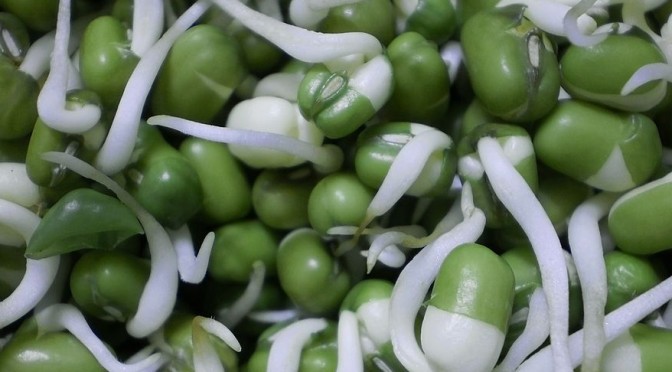
Munching on Mung Beans

Well, not really. I haven’t actually seen a mung bean in my grocery store, so I suspect I will need to visit an Asian market to actually find the bean. But what I do find at the market is bean sprouts and the majority of those consumed in the United States are from the mung bean seed. Those are those delightfully crunchy sprouts that go so well in Chinese food and in salads. But as for the beans themselves, they are also mashed into a mung bean paste that is used in Asian and Indian cooking. What are we missing out on?

Actually, the bean is usually dried for use, then boiled until they are soft. The paste can be made by removing the outer hull, cooking and then pulverizing the beans until they are a dry paste. In some regions of India, the hulled beans are used to make mung dal.  Other areas of India season the whole beans with spices and fresh coconut to make sundal.

Chinese cuisine used the whole bean to make a dessert called lǜdòu tángshuǐ. Dehulled mung beans and mung bean paste are used in Hong Kong to make ice cream. Mung bean paste is used as a filling for mooncakes in East China and Taiwan. Boiled and shelled beans are used as filling in rice dumplings that are eaten during the dragon boat festival.They can also be blended into a sweetened beverage.

In Indonesia, the beans are cooked with coconut milk and ginger to make es kacang hijau, which is a porridge-like dessert. Monggó guisado or balatong is a Filipino stew of whole mung beans with prawns or fish. Again, mung bean paste is used to make a sweet pastry called a hopia that is popular in the Philippines, Indonesia and Guyana, where it is called a black eye cake.

History

Since ancient times, the mung bean has been grown in India and is now widely grown in southeast Asia, Africa, South America and Australia. It seems to have been cultivated in the United States as early as 1835 where it was known as the Chicksaw pea. Although the beans are widely grown for human consumption, they can also be used as a manure crop and as forage for livestock.Of the fifteen to twenty millions pounds of mung bean consumed annually in the US, nearly 75% is imported. The rest is primarily grown in Oklahoma.

The mung bean sprouts are what we see most often in groceries. They are high in protein, calcium, phosphorus and some vitamins as well as low calorie and low carb. This makes them very important for providing protein in areas where people don’t have many other sources.

1200px-Bean_sprouts_04
Mung Bean sprouts – Photo from WikiCommons – “Bean sprouts 04” by Anna Frodesiak – Own work. Licensed under CC0 via Wikimedia Commons


Nutrition information
Mung Beans 1 tablespoon
Calories: 45, Fat: 0.2 g,Net Carbs: 5.9 g, protein: 3.1 g

Bean sprouts 1 cup
Calories 31, Fat 0 g, Net Carbs: 4 g Protein: 3 g

Recipes

Asian fusion “Dirty” rice. Photo by R. Averett

Here’s a trio of recipes on Skinny Girl that use bean sprouts in them. I think I need to expand my use, although I do use them often in salads.

Egg Foo Yung
Orange Chicken
Asian Fusion “Dirty” Rice

 All comments relevant to my posts are welcome. SPAM is not.  If the post has nothing to do with my site content, it will not be posted.

Information for this article came from Purdue University – Alternative Field Crops Manual, Wikipedia, Food for LifeFood for Awakening

Top Photo from Wiki Commons, used with permission – “ചെറുപയർ മുളപ്പിച്ചത്” by Edukeralam, Navaneeth Krishnan S – Own work. Licensed under CC BY-SA 3.0 via Wikimedia Commons